Why Buy Tickets Early: Timing, Savings, and Seat Control


Buying tickets early is the most reliable way to secure good seats at face value before dynamic pricing and sellout risk take over. Fans attending concerts, sports events, or Broadway shows face a market where prices shift constantly based on demand, inventory, and timing. Advance ticket purchase, the industry term for buying before general availability closes, gives you control over both seat quality and cost. Understanding when and why to buy early is the difference between sitting where you want at a fair price and paying a resale premium for whatever is left.
Why buy tickets early: the core case for advance purchase
The single strongest reason to buy tickets early is seat selection. The best seats in any venue sell out first, often within hours of the public on-sale. Waiting even a few days after tickets go on sale can mean settling for obstructed views, back rows, or scattered singles. Early buyers get best seats at face value, while late buyers face an uncertain resale market with inflated prices and fewer options.
Price is the second major factor. Dynamic pricing, the system most major ticketing platforms now use, adjusts ticket prices in real time based on demand signals and remaining inventory. Prices are not fixed from the moment tickets go on sale. They move up as an event fills and can spike sharply in the final weeks before the show.

The benefits of early ticket purchase go beyond just saving money. Buying in advance removes the anxiety of watching prices climb or availability shrink. For fans with fixed travel plans, like flying in for a Broadway show or a playoff game, that certainty has real value.
When is the best time to buy tickets to save money?
Timing matters more than most fans realize. An analysis of 307,727 concert ticket sales found that median prices hit $99 on the day of the event and peaked at $162 in the 2–4 week window before the show. That peak zone is the most expensive time to buy for most events.
The data points to two sweet spots for buyers. Purchasing around 90 days before an event avoids the costly pre-event surge while still offering solid seat selection. The day of the event can also produce low prices, but that strategy carries real risk: sellout events will not drop in price, and your seat options shrink to whatever remains.
Timing window | Typical price behavior | Risk level |
90+ days before event | Near face value, wide seat selection | Low |
30–60 days before event | Prices begin rising with demand | Moderate |
2–4 weeks before event | Peak price window | High |
Day of event | Lowest median prices on resale | High (sellout risk) |
Day-of deals exist, but they are not reliable for high-demand shows. The 90-day window is the most consistent approach for fans who want both fair pricing and real seat choice.
Pro Tip: Set a calendar reminder the moment an event is announced. Tickets often go on sale 90–120 days out, and buying on the first day of public sale gives you the widest selection at the lowest primary market price.
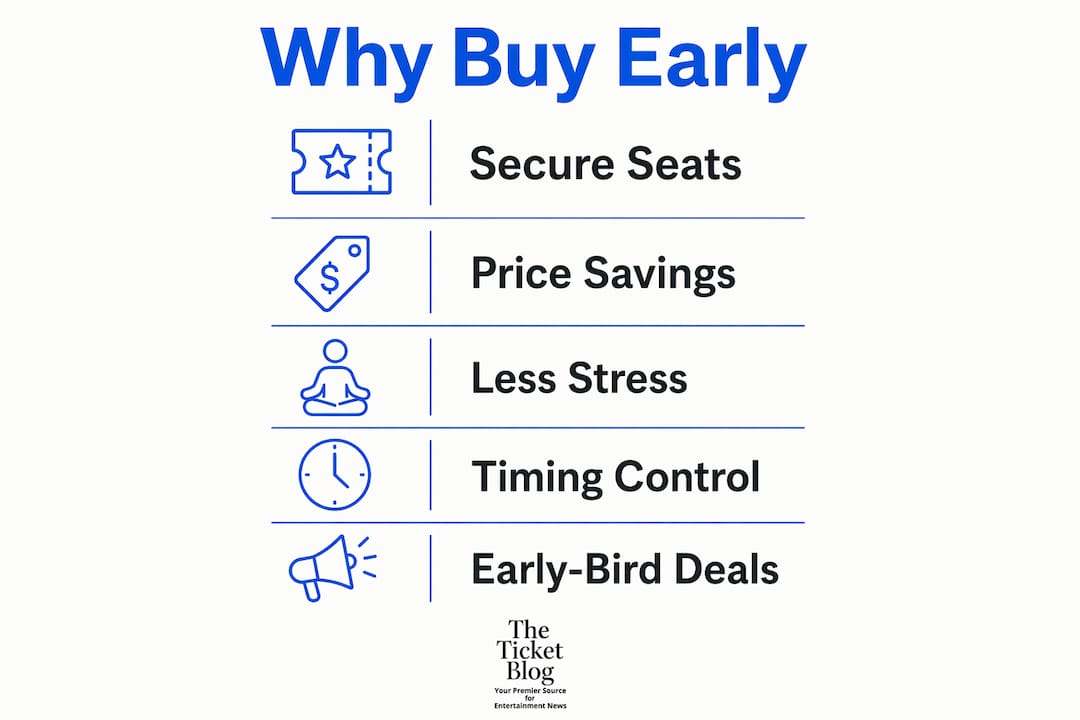
How does buying early improve seat selection and availability?
Seat selection is where the importance of buying tickets early becomes most concrete. Fixed-seat venues like concert halls, Broadway theaters, and sports arenas have a finite number of premium spots. Floor sections, front orchestra rows, and club-level seats disappear fast. Once they are gone from the primary market, they reappear only on resale platforms at a significant markup.
For high-demand shows, buying at or near the public on-sale is nearly always the right call. Events with limited capacity and strong fan bases, think stadium tours, playoff games, or long-running Broadway hits, rarely offer second chances at good seats through primary channels.
Broadway travelers with fixed schedules get a clear benefit from advance purchase. Buying tickets 4–6 weeks in advance locks in specific seats and dates during peak periods when shows near capacity rarely get cheaper or easier to access. For anyone flying in or booking a hotel around a show, that certainty is worth more than a potential last-minute discount.
The trade-off is flexibility. Buying early means committing to a date and seat before you know how your schedule will look. But for most fans attending a specific event they genuinely want to see, that trade-off favors buying early. The secondary market risks, including inflated prices, questionable guarantees, and limited seat choice, make early primary market purchase the safer path.
Pro Tip: For Broadway shows and major concerts, treat the public on-sale date like a flash sale. Have your payment details ready, log in early, and buy within the first hour. The best seats can be gone within 30 minutes of the on-sale opening.
What are early-bird tickets and how do they work?
Early-bird tickets are discounted, limited-time offers released before general admission goes on sale. Event organizers use them to generate early revenue, build buzz, and reward fans who commit ahead of the crowd. Early-bird tickets create urgency, social proof, and a quick revenue stream for organizers while giving buyers a genuine price advantage.
Sale windows for early-bird offers typically last anywhere from a few days to a couple of weeks. Once the allocation sells out or the window closes, prices move to standard general admission rates. Here is how to make the most of them:
Sign up for artist and venue newsletters. Early-bird announcements often go to email subscribers before they appear on social media or ticketing platforms.
Follow official social accounts. Artists and venues frequently announce early-bird windows on Instagram and X (formerly Twitter) with short notice.
Check fan club presales. Many artists offer fan club members access to early-bird pricing before the general public even knows tickets exist.
Act within the first 24 hours. Early-bird allocations are intentionally limited. Waiting even a day after the announcement can mean missing the discounted tier entirely.
Compare the full checkout price. Early-bird face value looks attractive, but service fees can add significantly to the total. The final checkout price is the number that matters.
Early-bird tickets represent one of the clearest advantages of advance ticket sales. They reward commitment with real savings, not just the promise of better seats.
How does event type affect when you should buy?
Not every event rewards the same buying strategy. The advantages of advance ticket sales are strongest for high-demand, limited-capacity shows. They are less clear-cut for events with large venue capacity, multiple dates, or low sellout risk.
Dynamic pricing models adapt based on predicted demand and inventory sell-through. A data-driven pricing study in football ticket sales showed that demand-based pricing produced 14% more tickets sold and 39% higher revenue compared to the prior season. That kind of model means prices are not arbitrary. They reflect real-time demand signals, so understanding the event type helps you predict how prices will move.
Event type | Early purchase benefit | Wait strategy viability |
Stadium concert tour | Very high: sellout risk, premium seats go fast | Low: resale premiums likely |
Broadway hit show | High: fixed seats, peak season fills quickly | Low for peak dates |
Regular season sports game | Moderate: good seats go early, but prices can drop | Moderate: sports ticket markdowns possible near game day |
Club or small venue show | High: limited capacity, no assigned seating tiers | Low: sells out without warning |
Large arena event, multiple dates | Moderate: early gets best seats | Moderate: extra dates reduce sellout risk |
Sports events with many games in a season and large venue capacity can see prices drop near game day if demand is lower than expected. That is where a wait strategy has merit. But for any event with a fixed date, limited capacity, and strong fan demand, the reasons to buy tickets in advance outweigh the case for waiting.
Key takeaways
Buying tickets early gives you the best combination of seat choice, price certainty, and protection from resale market premiums, making it the right default strategy for most high-demand events.
Point | Details |
Price peaks 2–4 weeks out | Avoid this window; buy around 90 days early or on the day of lower-demand events. |
Seat selection drives early purchase | Best seats sell out fast at public on-sale; waiting means fewer and worse options. |
Early-bird tickets offer real savings | Limited-time discounts reward early commitment before general admission pricing kicks in. |
Event type shapes your strategy | High-demand concerts and Broadway shows favor early purchase; some sports games allow waiting. |
Resale market adds cost and risk | Buying primary early avoids inflated resale prices and uncertain buyer guarantees. |
The Ticket Blog’s take on buying early in 2026
The conventional wisdom says “buy early to save money.” That is only half right. The real reason to buy early is control, not just cost. Seat selection at public on-sale is the moment when you have the most power as a buyer. After that, you are reacting to what the market leaves behind.
Dynamic pricing has made the timing question more complex. Prices no longer follow a simple “cheaper early, more expensive later” curve. The highest prices cluster in the 2–4 week window before an event, not at the start of sales. That means buying at public on-sale is often a sweet spot: good seat availability and prices that have not yet been pushed up by late demand.
The mistake most fans make is waiting to see if prices drop. For genuinely popular events, that wait usually ends in paying more on the resale market or missing the show entirely. The decision to buy early or wait comes down to how replaceable the event is to you. If missing it would genuinely disappoint you, buy early and buy primary.
— The Ticket Blog
The Ticket Blog can help you time your next ticket purchase
The Ticket Blog covers the full picture of ticket buying, from pricing trends and fee breakdowns to resale market guides and early-bird deal alerts. Whether you are planning for a concert, a Broadway show, or a big game, the site gives you the context to buy at the right time.
The guides on The Ticket Blog go beyond basic advice. You will find detailed breakdowns of how theater ticket pricing works, analysis of when prices peak and drop, and tips for spotting deals before they disappear. For fans who want to stop guessing and start buying with confidence, theticketblog.com is the resource built for exactly that.
FAQ
Why buy tickets early instead of waiting for a deal?
Buying early secures better seats at face value before dynamic pricing pushes costs higher. The 2–4 week window before most events is the most expensive time to buy, not the cheapest.
What is the cheapest time to buy concert tickets?
Day-of tickets carry the lowest median prices on the resale market, but sellout risk is high for popular shows. Buying around 90 days before the event balances price and availability more reliably.
What are early-bird tickets?
Early-bird tickets are discounted offers released before general admission, designed to reward early commitment and generate quick revenue for event organizers. Sale windows typically last days to a couple of weeks.
Does buying early always mean paying less?
Not always. Early purchase prioritizes seat choice and certainty over the absolute lowest price. For high-demand events, early primary market prices are still lower than resale premiums closer to the event date.
When should I wait to buy tickets instead of buying early?
Waiting makes sense for large-capacity sports events with multiple games in a season, where demand is lower and prices can drop near game day. For concerts, Broadway shows, and playoff games, waiting typically increases both cost and risk.
Recommended


Comments