Ticketmaster Fees Explained: What You Actually Pay For


Ticketmaster’s displayed ticket price must now include mandatory service and facility fees, thanks to the FTC’s all-in pricing rule that took effect in May 2025. Taxes and optional delivery charges can still get added at checkout, so the number you see on the seat map isn’t always your final total. Before you buy anything, check two things:
The “All In Price” listed on the event page and seat map
The subtotal dropdown at checkout, which breaks out exactly what you’re paying for
Venues typically set and keep most of the fee revenue on a ticket. Ticketmaster’s own cut is smaller than most fans assume. Once you know where to look and who’s actually charging what, the whole process gets a lot less frustrating.
Key Takeaways
The FTC’s all-in pricing rule forces Ticketmaster to show mandatory service and facility fees upfront, but taxes and delivery costs can still change your total at checkout.
Point | Details |
Check the All In Price | Look at the seat map price first, since it must legally include mandatory service and facility fees. |
Watch for late additions | Taxes and optional delivery fees can still be added during checkout, changing your final total. |
Venues keep most fee revenue | Ticketmaster typically retains around 5 to 7 percent of the total ticket price, per reporting. |
Compare total, not face value | A cheaper listed seat can end up costing more once its fee percentage is factored in. |
Use The Ticket Blog’s guides | The Ticket Blog tracks promo codes and fee patterns to help you find lower all-in totals before you buy. |
Table of Contents
Ticketmaster Fees Explained: A Breakdown of What You’re Charged
Every Ticketmaster order can include several distinct charges stacked on top of face value. Here’s what each one actually means:
Service fee. This is the largest and most familiar charge, covering platform operations, customer support, and fraud protection. It’s typically calculated as a percentage of the ticket price.
Facility fee. Set by the venue, not Ticketmaster, this covers building maintenance, security staff, and on-site infrastructure. It varies widely from one venue to the next.
Delivery or fulfillment fee. Mobile transfer is often free or cheap; physical shipping or will-call processing can cost more. This is one of the few charges that may still appear after the initial price display.
Order processing fee. This used to be a common standalone line item. Many platforms folded it into the service fee after the 2025 all-in pricing crackdown, though the underlying cost didn’t necessarily disappear.
Taxes. Local and state sales tax on tickets varies by jurisdiction and is calculated at checkout, since it depends on the buyer’s location and the venue’s.
Under the FTC’s all-in pricing rule, the service fee and facility fee must be baked into the price shown on the event page and seat map. Taxes and certain delivery fees are the exceptions. They’re allowed to show up later in the checkout flow, which is why your final total can still creep up after you pick your seats.
Who Actually Sets and Keeps Ticketing Fees?
Ticketmaster doesn’t unilaterally decide what you pay. Venues negotiate fee structures directly into their contracts, and they typically set the facility fee themselves. Promoters also have a say in how tickets are priced and packaged.
Venues commonly retain the majority of total fee revenue on a given ticket
Ticketmaster’s direct share tends to run in the range of roughly 5 to 7 percent of the total ticket price, according to reporting from The Guardian
Fee levels swing widely by venue size, market, and the specific terms each contract spells out
That last point explains a lot of the confusion fans feel when comparing fees across two shows at different arenas. A 20,000 seat stadium with high security overhead and a 500 seat theater aren’t working from the same cost structure, and their contracts with Ticketmaster reflect that. Understanding how venue fees get built into ticket costs makes the wide variation across shows a lot less mysterious.
What Does the FTC All-In Pricing Rule Actually Change?
The rule, which took effect in May 2025, requires that the price shown on an event listing or seat map include all mandatory fees the seller controls, according to the FTC’s own guidance. That means service and facility fees can no longer be sprung on you at the last screen before payment.
Here’s what’s still allowed to appear later:
Government-imposed taxes, since they depend on your location
Optional delivery fees, if you choose a method beyond standard mobile transfer
Ticketmaster’s own help documentation confirms the All In Price is meant to reflect the true total, with a subtotal dropdown available so you can see exactly how that number breaks down. Some sellers responded to the rule by renaming or consolidating fee line items rather than lowering the underlying total, so the price you land on may look cleaner without actually being smaller.
Pro Tip: Don’t assume “all-in” means “lowest possible.” It means transparent. Compare the all-in total across a few seat options before you commit, since fee percentages can shift depending on section and price tier.
How Do You Find the True Total Price on Ticketmaster?
Spotting the real cost takes about 30 seconds once you know the sequence. Follow this before you click purchase:
Open the event listing and look at the price shown on the seat map. This should already reflect the All In Price.
Select your seats, then check the subtotal dropdown on the next screen for the itemized breakout.
Review your delivery options. Mobile transfer is usually the cheapest; shipping or upgraded delivery can add cost.
Confirm taxes at the final checkout step, since these are calculated based on your billing location.
Compare that final number against the price you saw when you first opened the seat map.
Pro Tip: Screenshot your seat map price before selecting seats. Ticketmaster’s dynamic pricing can shift the total for the same section within minutes, and having a screenshot lets you confirm whether the jump came from demand pricing or an added fee.
Practical Ways to Reduce or Avoid Extra Ticketmaster Fees
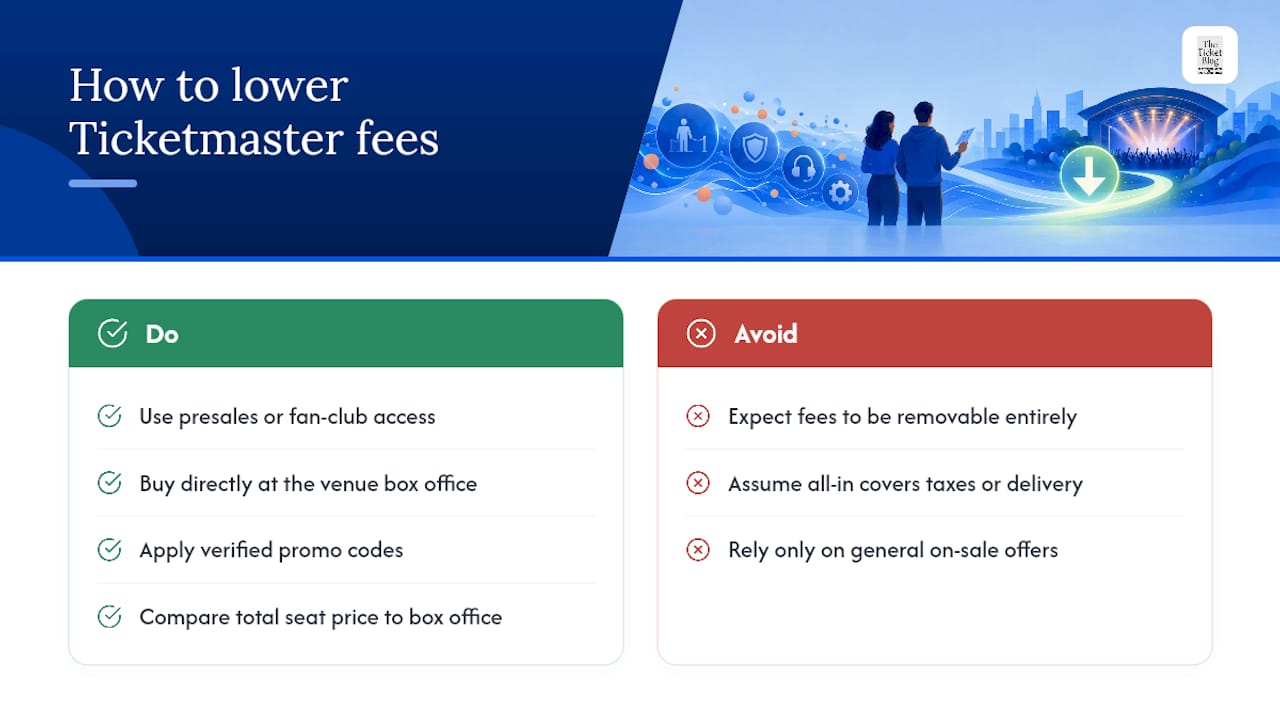
The single best habit: compare total seat-level price, not face value, before deciding a seat is a good deal. A $60 face-value seat with a 30% fee load can end up costing more than a $70 seat with lower fees attached.
Join artist fan clubs and register for presales, which sometimes carry lower fee structures than general on-sale
Buy directly at the venue box office when that option exists, since it can bypass online platform fees entirely
Use verified promo codes rather than third-party discount sites that reroute you off-platform
Choose mobile transfer over shipped tickets when fees are a concern
Watch for late price drops on unsold inventory, particularly for shows that haven’t sold through
Platforms and venues consistently point buyers toward one habit above all others: look at the total price first, not the sticker price, and use official presale or box office channels whenever they’re available.
Steer clear of off-platform deals that promise a “no fee” ticket in exchange for payment outside a verified marketplace. Those transactions carry no buyer protection, and a shockingly high number end in tickets that never materialize. If you want a deeper playbook, The Ticket Blog’s guide to avoiding concert ticket fees walks through timing and channel strategy in more detail. For last-minute price drops, understanding why unsold tickets get discounted helps you judge when waiting actually pays off.
Are Ticketmaster Fees Really Just “Junk Fees”?
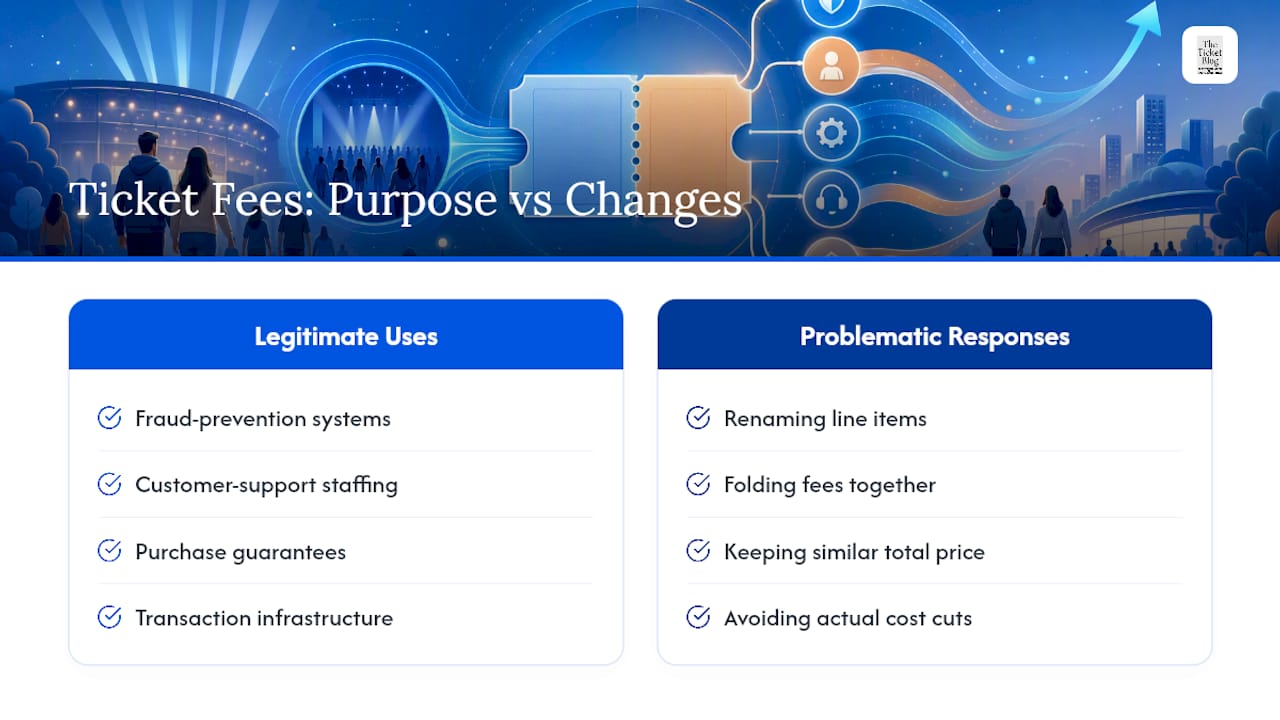
Not entirely. Fees fund real operational costs: fraud prevention systems, customer support staffing, purchase guarantees, and the technology infrastructure that processes millions of transactions during a single on-sale. Marketplace’s reporting on the industry backs this up. Fee-sharing between venues and ticketing companies is a standard, contract-driven practice, not an arbitrary markup invented at checkout.
That said, the 2025 crackdown exposed a real problem. Some platforms responded by renaming or folding line items together rather than cutting costs, so buyers sometimes paid a similar total under a cleaner-looking price. Antitrust scrutiny of the live event industry has also pushed some venues toward negotiated fee caps, which is slowly reshaping contracts venue by venue.
Why We Track Ticketmaster’s Fee Structure So Closely
Fee structures shift constantly, and staying current means following FTC enforcement, platform documentation, and reporting from outlets covering the live events industry. The Ticket Blog builds its guides from that same groundwork, including tactical breakdowns like hidden ticket fee discounts. If you’ve spotted a fee pattern worth flagging or found a promo code worth sharing, we want to hear about it.
Find Better Ticket Deals Without the Fee Guesswork
The Ticket Blog exists to do the fee homework so you don’t have to. Instead of hunting through seat maps and subtotal dropdowns for every show you’re eyeing, you get curated promo codes, presale timing tips, and venue-specific fee breakdowns in one place.

We link out to ticket marketplaces and official sellers as part of how the site earns revenue, and we’re upfront about that. Our job is pointing you toward the option that actually saves you money on a given show, not just the one that pays us the most. Start with our guide to avoiding concert ticket fees for tactics you can use on your very next purchase, or browse current hidden fee discounts before your next on-sale date.
Frequently Asked Questions
Why are Ticketmaster fees so high? Fees fund venue operations, fraud prevention, customer support, and platform infrastructure. Venues typically set facility fees and keep most of the revenue, while Ticketmaster’s own cut runs around 5 to 7 percent of the total price.
How do I avoid Ticketmaster fees entirely? You generally can’t avoid fees completely on Ticketmaster, but you can lower them by using presales, fan club access, venue box office purchases, and verified promo codes instead of general on-sale.
Does the all-in pricing rule mean I’ll never see a price change at checkout? No. Taxes and certain delivery fees are excluded from the rule and can still be added after you select seats, so always check the subtotal dropdown before paying.
Are StubHub fees explained the same way as Ticketmaster’s? Similar logic applies. StubHub and other secondary marketplaces also face all-in pricing requirements and describe their fees as covering infrastructure, guarantees, and customer support.
Are Ticketmaster fees worth it? That depends on the show and your alternatives. Fees pay for real services, but comparing total seat-level price against box office or presale options often reveals a cheaper path to the same seat.
Sources
Recommended


Comments