Why Concerts Have Multiple Ticket Tiers Explained


Why concerts have multiple ticket tiers: the core idea
Concerts use multiple ticket tiers as a deliberate pricing strategy, as explored by title records — record store in adelaide, australia | Vinyl Atlas, not an accident of logistics. A tier is a fixed price level for the same event, released sequentially so that earlier buyers pay less and later buyers pay more. When Tier 1 sells out, Tier 2 opens at a higher price. When Tier 2 goes, Tier 3 follows at a higher price still.
The system serves everyone involved in the show:
Artists and promoters capture more total revenue by matching price to demand at each stage.
Early fans get rewarded with the lowest face value available.
Venues fill seats faster, reducing the risk of unsold inventory close to show night.
The market signals real demand, which helps set expectations for future tours.
Research published in Managerial and Decision Economics puts the average revenue gain from multi-tier pricing at approximately 5% per show over uniform pricing, reflecting the typical increase found when comparing tiered and single price ticketing.
Table of Contents
How ticket tiers actually work when sales go live
The mechanics are straightforward once you see them in sequence. A platform like DICE releases Tier 1 at the lowest price the moment tickets go on sale. That tier has a fixed quantity. Once those seats or general admission spots are gone, the platform automatically unlocks Tier 2 at the next price point, and so on.
Here is what that looks like from a buyer’s perspective:
Checkout reflects the current tier. You cannot choose a lower tier that has already sold out; the platform shows only what is available now.
Venue seating shapes the tiers. A general admission floor may have one or two tiers based purely on quantity, while an arena with reserved sections can layer tiers by both price and seat location.
Prices update in real time as tiers sell out, but the price within any active tier stays fixed until that tier closes.
Pro Tip: Set a ticket alert the moment a tour is announced. The gap between Tier 1 and Tier 3 prices can be significant, and that window closes fast for high-demand shows.
Tiered pricing is not the same as dynamic pricing, and the distinction matters. Tiered pricing uses pre-set fixed price buckets released in sequence, while dynamic pricing adjusts prices in real time using algorithms tied to live demand signals. Many fans confuse the two, especially when prices seem to jump overnight, but a tier change is a planned step, not a surge.

Why promoters and artists build multiple price tiers into every show
The motivations behind tiered concert ticket pricing go deeper than simple profit maximization. Several forces push promoters toward this structure.
Rewarding loyal fans. Buyers who follow an artist closely and act fast get the lowest price. Early buyers gain access to the lowest-priced tiers, creating a genuine incentive to commit before the general public catches on.
Covering production costs. Concert ticket pricing involves complex cost calculations beyond the artist’s fee, including venue rent, staffing, lighting, audio, and permits. Tiers help ensure those costs are covered even if early sales move slowly.
Reducing unsold inventory risk. Sequential releases build momentum. Each sold-out tier generates buzz that drives demand for the next, so promoters arrive at show night with fewer empty seats.
Serving fans at different price points. Not every fan can spend the same amount. Tiers let a $50 buyer and a $150 buyer attend the same show, broadening the audience without leaving money on the table from fans willing to pay more.
Managing secondary market pressure. When face value tiers are priced closer to true market demand, the gap that scalpers exploit shrinks. It does not eliminate resale markups, but it reduces the arbitrage opportunity.
Genre and artist popularity differences. A club show by an emerging indie act may have just two tiers separated by $10. A stadium tour by a major pop artist can run four or five tiers with $80 or more between the lowest and highest. The structure scales with demand.
Promoters use historical venue sales data to decide how many tickets go into each tier, not guesswork. Artists set revenue targets; promoters and venues handle the implementation.
What market data reveals about ticket tiers and fan access
The tiered pricing model has real consequences for who gets to attend live music. Market analysts point to a growing divide in concert spending, and the data is hard to ignore.
Higher-income fans continue to absorb premium tier prices without hesitation.
Lower-income fans are increasingly limited to the lowest tiers, and when those sell out instantly, they are effectively priced out of the show.
This “K-shaped” demand curve means tier structures are not neutral. They reflect and reinforce existing economic gaps in who can access live music.
The accessibility concern is real, but it does not mean tiers are inherently unfair. The lowest tier, by design, is the most affordable option at face value. The problem arises when demand is so high that Tier 1 vanishes in minutes, leaving only premium tiers for fans who were not online at the exact right moment. Understanding why concert tickets are so expensive starts with recognizing that production costs, not arbitrary decisions, drive the floor price of every tier.
For fans navigating this system, knowing how tiers work is the first practical advantage. Check out The Ticket Blog’s guide to concert ticket discounts to find ways to stretch your budget across any tier level.
Key Takeaways
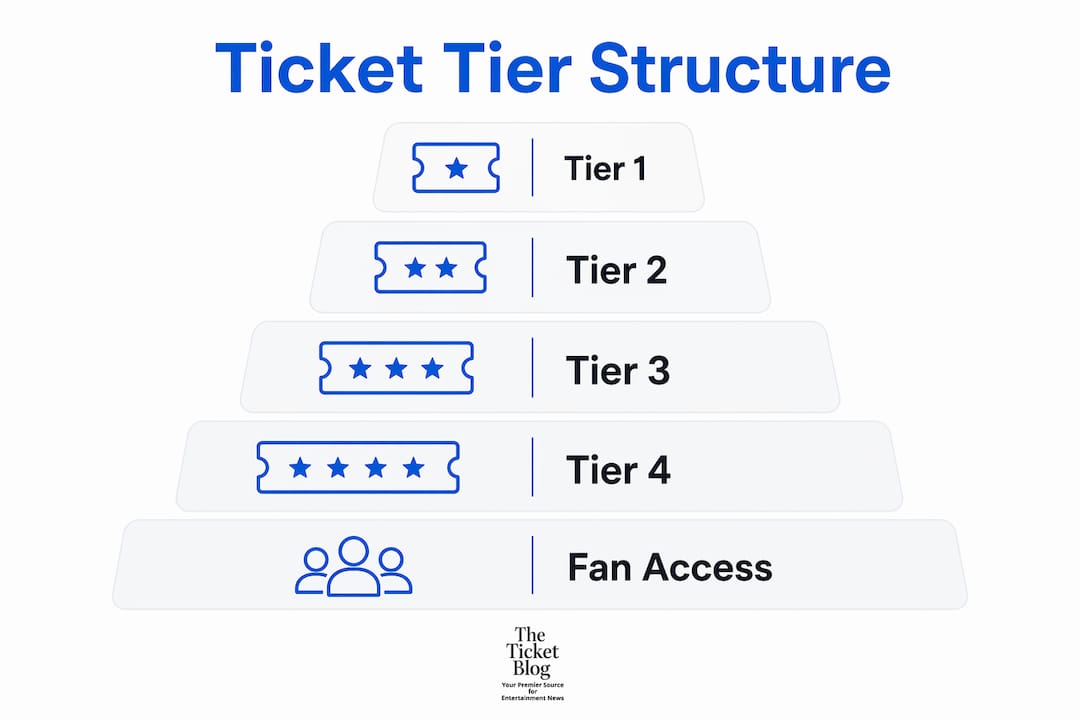
Concerts use multiple ticket tiers primarily to reward early buyers, cover production costs, and capture revenue across fans with different budgets.
Point | Details |
Tiers reward early action | The lowest-priced tier goes first; buying early is the most reliable way to pay face value. |
Revenue impact is measurable | Multi-tier pricing generates an average 4.2% revenue gain per show over uniform pricing. |
Tiers differ from dynamic pricing | Tiered prices are fixed and pre-set; dynamic pricing fluctuates in real time based on algorithms. |
Promoters set tier quantities strategically | Historical sales data, not guesswork, determines how many tickets go into each tier. |
Accessibility is a real trade-off | The K-shaped demand curve shows lower-income fans are increasingly limited to early tiers that sell out fast. |
Recommended


Comments