Away Fan Ticket Buying Strategies That Actually Work


To maximize your chances of scoring away tickets right now, do these things before the next sale opens: get on the presale list for your club’s away scheme, create and verify your accounts on Ticketmaster and any relevant resale platforms, save your payment method with one-click checkout enabled, identify one trusted backup buyer, decide which seat sections you’ll accept, and set resale alerts at your ceiling price. That’s the whole game in six steps. Everything below explains how to execute each one at the level that separates fans who get in from fans who watch the countdown hit zero.
Join your club’s away membership or supporter scheme immediately.
Create verified accounts on Ticketmaster, SeatGeek, StubHub, and Vivid Seats.
Save a primary and backup payment card with Express Checkout or one-click enabled.
Identify one trusted backup buyer and confirm your transfer method with them now.
Decide in advance which sections you’ll accept (not just your ideal seats).
Set price and inventory alerts on at least two verified resale platforms.
Bookmark the official home-team ticket page and your club’s away ticket portal.
Plan to enter the waiting room 20–30 minutes before the sale opens.
Pro Tip: The single highest-leverage move most fans skip is designating a backup buyer before sale day. Pick one person you trust, confirm they have a verified account on the same platform, and agree on a seat-transfer method in writing. Two coordinated buyers entering simultaneously doubles your shot at adjacent seats.
Key Takeaways
The most repeatable away fan ticket buying strategy combines early presale access, verified account prep, a coordinated backup buyer, and active monitoring of the 72-hour resale window before the event.
Point | Details |
Presale access is the priority | Join your club’s away scheme and register credit-card presale perks before any specific fixture is announced. |
Account prep eliminates checkout friction | Save payment methods and verify accounts on Ticketmaster, SeatGeek, StubHub, and Vivid Seats at least 48 hours before the sale. |
Backup buyer doubles your chances | One trusted, coordinated buyer entering the waiting room simultaneously significantly improves your odds of securing adjacent seats. |
The 72-hour window is the best resale entry point | Resale prices on verified platforms often soften in the final 72 hours before an event, making it the most efficient time to buy secondary-market tickets. |
The Ticket Blog’s guides cover every stage | The away-game ticket guide and sold-out alternatives guide provide tested workflows and timing checklists for every step of the process. |
Table of Contents
What’s the best day-of-sale playbook for getting away tickets?
How to be flexible about seats and still enjoy the away experience
Why do tickets reappear, and how do you catch late releases?
Which verified resale platforms should you use if you miss the primary sale?
Away-specific tactics involve allocations, loyalty considerations, and ID rules
The Ticket Blog has the guides you need for your next away trip
How do presales work, and how do you qualify for them?
Presales are early-access windows that open before the general public sale, and they’re often where the best seats go. The key is knowing which pipelines exist and qualifying for as many as possible before the sale date is announced.
Common presale sources for away fans:
Club/away allocation presales: Your club receives a block of tickets from the home team and distributes them to members first, usually in loyalty-point order.
Credit-card issuer presales: Cards like Citi, American Express, and Capital One frequently offer early access through Ticketmaster and other primary platforms. Enroll your card in the issuer’s presale program before you need it.
Venue and promoter presales: Sign up for the home venue’s e-mail list and follow their official social channels. Venue presale codes often go out 24–48 hours before the general sale.
Sponsor and partner codes: Official sponsors of leagues or clubs sometimes distribute presale codes through their own apps or loyalty programs.
Steps to qualify for each pipeline:
Join your club’s away scheme or membership program as early as possible in the season.
Opt into e-mail notifications from the home venue and both clubs’ official channels.
Register your credit card for presale perks through your card issuer’s portal.
Follow the official club and venue accounts on social media for code drops.
Check your club’s official app the morning presale codes are typically released.
Presales don’t all open at the same time. Club allocation windows usually open first, followed by credit-card presales, then venue lists, and finally the general public sale. If you’re in multiple pipelines, prioritize the club allocation window because those seats are specifically reserved for away fans, which means you’ll be sitting with your own supporters.
Pro Tip: Legitimate fan forums and official supporter trust channels sometimes share presale codes when a club or venue permits it. Stick to official supporter groups and club-sanctioned communities. Using a code from an unofficial source can result in canceled tickets if the platform flags it as misuse.
Set up your accounts and payment before sale day
Friction on purchase day costs tickets. The fans who lose out are often the ones who hit a login error, a declined card, or a delivery-preference screen they’ve never seen before. Removing those obstacles in advance is one of the most reliable away fan ticket tips you can follow.
Ticketmaster’s official guidance specifically recommends creating your account in advance, saving payment information, and testing your setup before the sale. That advice applies equally to SeatGeek, StubHub, and Vivid Seats.
Account and payment setup checklist:
Create and verify accounts on the home-team’s primary ticketing platform and all major resale marketplaces.
Confirm your e-mail address and phone number are verified on each account.
Save a primary payment card and a backup card. Enable Express Checkout or one-click purchase wherever the platform offers it.
Set your ticket delivery preference to mobile transfer, which is the fastest and most transferable option for away games.
Understand the event’s ID or collection rules. Some venues require the purchasing cardholder to collect in person.
24–48 hours before the sale, run this mini-checklist:
Log in to every account you plan to use and confirm your password works.
Check that your saved payment card hasn’t expired and the billing address is current.
Do a test purchase or token authorization on a low-cost item to confirm the card clears.
Screenshot the e-ticket flow so you know exactly where to tap when the clock is running.
Open the sale page in a fresh browser profile with cookies cleared, and bookmark it.
Confirm your backup buyer has done the same on their account.
Pro Tip: Have your backup buyer’s account details and your agreed transfer method written down somewhere you can access without unlocking your phone. When you’re in a waiting room with 50,000 other fans, you don’t want to be searching through messages to remember which platform you’re transferring on.
What’s the best day-of-sale playbook for getting away tickets?
The waiting room is where most fans make avoidable mistakes. Refreshing the page, switching browsers mid-queue, or waiting until the sale opens to log in are the three fastest ways to lose your spot.
Step-by-step sequence for sale day:
Log in to your primary account 20–30 minutes before the sale opens. Don’t wait until the countdown hits zero.
Clear your browser cache and cookies the night before, then use a dedicated browser profile for the sale.
Navigate to the sale page and enter the waiting room as soon as it opens. Do not refresh unless the platform explicitly instructs you to.
On a second device (mobile), have your backup buyer enter the same waiting room simultaneously with their own account.
When you reach the ticket selection screen, move quickly. Most platforms hold seats in your cart for only 8–10 minutes.
If your cart times out, don’t close the browser. Return to the queue immediately; seats from timed-out carts often reappear within minutes.
Device strategy: Use a desktop or laptop as your primary device because form fields, seat maps, and checkout flows are faster to navigate on a larger screen. Keep your phone as a secondary entry point with your backup buyer logged in. Coordinate by text or a shared note so you’re not selecting the same seats.
For form speed, use your browser’s built-in autofill for name and address fields. Saved payment cards eliminate the slowest step in checkout. Legitimate browser extensions like Dashlane or 1Password can auto-fill credentials without violating platform terms, but avoid any extension that automates clicks or seat selection, which crosses into bot territory.
A quick scenario: Two coordinated buyers enter the waiting room at the same time. Buyer A targets the upper-corner away section. Buyer B targets the adjacent block one section over. They text each other row numbers as they land. If Buyer A gets seats in Row 12, Buyer B can pivot to Row 11 in the neighboring block. Both end up within shouting distance of each other.

Pro Tip: If your cart fails and the queue is gone, pivot immediately. Don’t spend 20 minutes retrying the primary sale. Set your resale alerts and check the official exchange within the hour. Prices on verified resale platforms often spike right after a sellout, then drift back down over the following days.
How to be flexible about seats and still enjoy the away experience
Away fans rarely get to choose their ideal section. The visiting allocation is usually a fixed block, often upper corners or a designated end, and availability within that block disappears fast. Flexibility isn’t settling; it’s a deliberate strategy.
Practical seat rules for away fans:
Target upper-corner sections and upper tiers behind the away end first. These are where visiting supporters typically concentrate, which matters for atmosphere and safety.
Look for blocks with known away-fan concentrations at that specific venue. A quick search of fan forums before sale day will tell you which sections visiting supporters have historically occupied.
If the designated away section is sold out, consider upper-tier neutral sections rather than lower-bowl areas surrounded by home fans.
Avoid lower-bowl sideline seats in heavily partisan venues unless you’re comfortable sitting quietly. Wearing away colors in the wrong section creates unnecessary friction.
Reading the seat map under time pressure: Filter by price range first to eliminate sections outside your budget. Then sort by availability. Don’t spend more than 60 seconds on the map before selecting. A slightly higher row or a seat two sections off-center is almost always better than losing the ticket entirely.
Acceptable tradeoffs that still deliver a good experience:
Row 20 instead of Row 10 in the away block: you lose some proximity but gain atmosphere.
One section to the left of the prime away corner: you’re still with traveling supporters and the view is comparable.
Upper tier instead of lower bowl: sight lines are often better, and you’re among your own fans.
The goal is to be in the building with your group. A seat that’s 15 rows higher than you wanted beats watching the game from a sports bar.
Why do tickets reappear, and how do you catch late releases?
Tickets reappear after an initial sellout for several predictable reasons, and knowing the timeline helps you position yourself to catch them.
Why tickets come back:
Cart timeouts: A fan holds seats in their cart but doesn’t complete checkout within the platform’s time limit (usually 8–10 minutes). Those seats return to inventory automatically.
Payment failures: Declined cards or expired payment methods release held seats back into the queue.
Production holds: Venues and promoters hold blocks for production, media, and sponsor use. These are released to the public as the event approaches, often 2–4 weeks out.
Season-ticket-holder releases: Season-ticket holders who don’t claim their allocation by a deadline have their seats released. As noted in NFL away-game ticket research, these primary windows are often the best opportunity for face-value seats before resale prices climb.
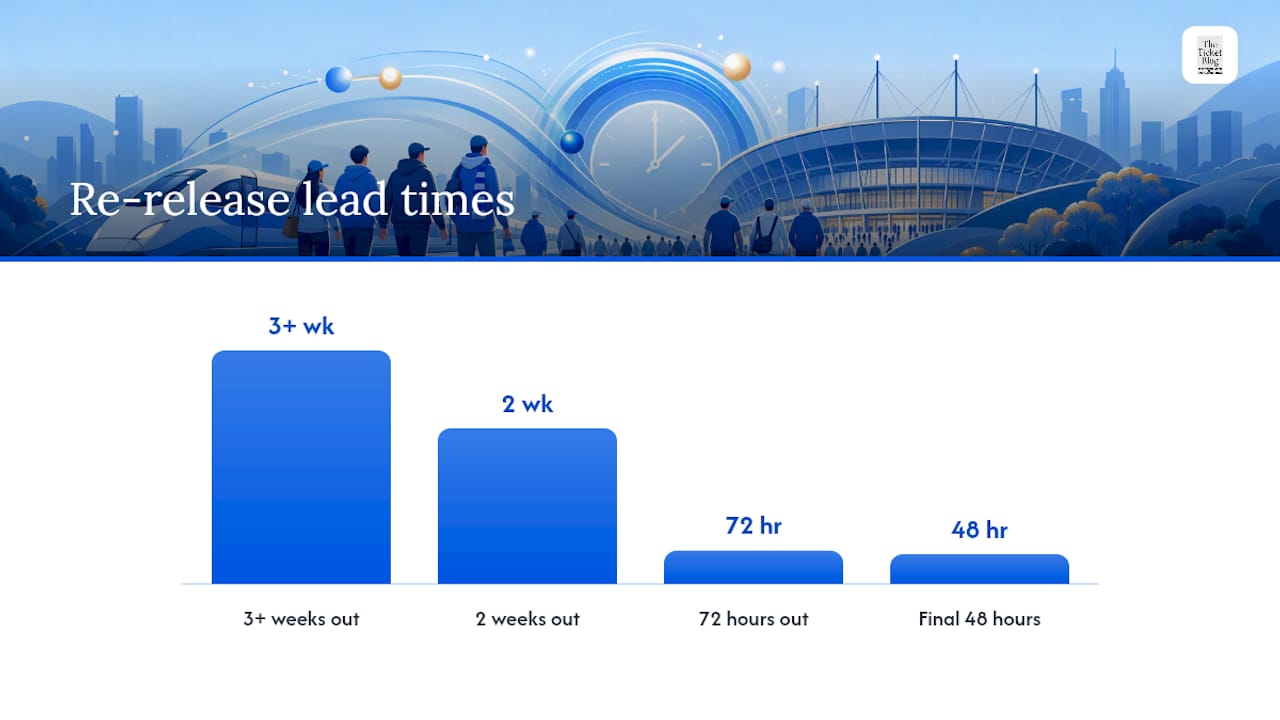
Typical availability and price timeline:
Lead Time | What Usually Happens |
3+ weeks out | Primary sale opens; face-value seats available; resale prices spike above face value immediately after sellout |
2 weeks out | Production holds begin releasing; some face-value seats reappear on official exchanges |
72 hours out | Resale prices often soften as sellers reduce to move inventory; cart-drop monitoring is most productive |
Day of event | Last-minute drops from no-shows and seller nerves; prices can fall significantly below earlier resale highs |
How to monitor for late releases:
Set price alerts on SeatGeek, StubHub, and Vivid Seats at your ceiling price.
Check the official home-team ticket exchange daily starting two weeks out.
Follow the home club’s official social accounts for any announcement of released holds.
Use the platform’s “notify me” feature if available, which sends an e-mail or push notification when seats matching your criteria appear.
Pro Tip: In the final 48 hours, refresh the official ticket exchange manually every 30–60 minutes rather than relying solely on alerts. Alert delays can run several minutes, and in a fast-moving inventory window, that gap matters. This manual approach stays within platform terms as long as you’re not using automated scripts.
Which verified resale platforms should you use if you miss the primary sale?
Missing the primary sale doesn’t mean missing the game. Verified resale platforms offer buyer guarantees and transfer tools that make secondary-market purchases relatively safe, provided you use the right ones and verify your purchase properly.
Platforms worth using for away fans:
Ticketmaster Verified Resale: Tickets are transferred through Ticketmaster’s own system, which means the barcode is validated before you receive it. The buyer guarantee covers you if a ticket is invalid at the gate.
SeatGeek: Offers a Deal Score feature that rates ticket value relative to comparable seats, which helps you avoid overpaying. Buyer guarantee covers invalid or canceled tickets.
StubHub: One of the largest secondary markets in the U.S., with a FanProtect guarantee that covers you if tickets don’t arrive or are invalid. Transfer is typically digital.
Vivid Seats: Rewards program and buyer guarantee. Useful for monitoring price trends across a large inventory pool.
For a deeper look at how these platforms handle resale mechanics and buyer protections, The Ticket Blog’s ticket trade guide walks through the specifics of each marketplace.
Setting alerts and timing your purchase:
Set alerts at 10–15% above your true ceiling price so you don’t miss a brief dip.
The 72-hour window before the event is historically when resale prices soften most, based on season-ticket-holder release patterns.
If you’re monitoring multiple platforms, check them at the same time each day so you’re comparing current prices, not prices from different points in the day.
Post-purchase verification checklist:
Confirm the platform’s buyer guarantee covers your specific ticket type.
Check that the ticket was transferred via the platform’s official tool, not a screenshot or PDF from an unknown seller.
Review the seller’s transaction history if the platform shows it.
Save your order confirmation and the platform’s support contact before the event.
Pro Tip: Set alerts on two platforms simultaneously at your ceiling price. When one triggers, check the other before buying. You may find a lower price on the second platform for the same section, and having both alerts active means you’re comparing live inventory rather than guessing.
If you’ve already missed the initial sale and need alternatives beyond resale, The Ticket Blog’s guide to sold-out game ticket alternatives covers additional options worth checking.
Away-specific tactics involve allocations, loyalty considerations, and ID rules
Away tickets operate differently from general public sales. Home teams control the inventory, and the visiting club receives a capped allocation that gets distributed through its own priority system. Understanding that system is the foundation of every other tactic.
Arsenal’s official away ticket guidance illustrates how club-controlled allocation works in practice: members access tickets in priority order based on loyalty points and previous away attendance, with the most in-demand fixtures reserved for fans who’ve built the longest history.
Premier League away allocations follow the same principle across the league: loyalty points and attendance history are the gatekeepers, and new fans are directed toward lower-demand fixtures to start building priority. The same logic applies across major U.S. sports leagues, where season-ticket holders and loyalty-program members get first access before tickets reach the general public.
Practical steps to build away priority:
Join your club’s official away scheme at the start of the season, not when a specific fixture is announced.
Attend lower-demand away fixtures first. These are easier to access and build your attendance record simultaneously.
Log every away match you attend through your club’s official system so the credits register.
Check your loyalty-point balance before each sale window opens so you know your priority tier.
Handling ID and collection rules:
Digital mobile transfer is the standard for most U.S. venues. Confirm this is the delivery method before completing your purchase.
Some high-demand or international fixtures require the purchasing cardholder to collect in person with photo ID. Check the event-specific terms, not just the platform’s general policy.
If a friend is collecting on your behalf, confirm whether the venue permits authorized collection and what documentation they’ll need.
Behavior and safety tips for away fans:
Sit with your group whenever possible. Isolated away fans in home sections attract unnecessary attention.
Wear your colors in the designated away section. In neutral or mixed sections, use your judgment based on the venue’s atmosphere.
Secure your ticket before booking travel. TheFans’ guide to away days abroad makes this point clearly: club systems vary widely, and non-refundable travel booked before a ticket is confirmed is a common and avoidable mistake.
Pro Tip: Build your away attendance record on fixtures you’d genuinely enjoy attending, not just the ones you think will earn the most points. Sustainable away travel means you’re still doing it in three seasons, not burned out after one.
Legal and security cautions every away fan should know
The demand for away tickets creates a market for fraud, and the tactics used by scammers have gotten more convincing. A few firm rules protect you.
What you must not do:
Do not use automated bots or scripts to enter queues, hold seats, or complete purchases. This violates platform terms of service and can result in permanent account bans and canceled tickets.
Do not exceed the per-person ticket limit set by the platform or event. Purchasing above the limit using multiple accounts is a violation that can result in all tickets being voided.
Do not participate in off-platform transactions, including bank transfers, cash deals, or tickets sold via social media direct messages without a platform guarantee.
Security checks before and after purchase:
Confirm the platform you’re buying from has a published buyer guarantee and a clear dispute process.
Prefer digital transfer through the platform’s official tool over PDF tickets or screenshots, which can be duplicated and resold to multiple buyers.
Validate that the ticket format matches what the venue accepts. Most major U.S. venues now require mobile barcodes, not printed tickets.
Save your order confirmation, the seller’s username or ID, and the platform’s support contact before the event.
If a ticket is invalid at the gate:
Contact the platform’s support immediately and show your order confirmation.
Document everything: screenshots of the ticket, the error message at the gate, and your purchase receipt.
Most major platforms (Ticketmaster, SeatGeek, StubHub, Vivid Seats) have guarantee processes that can resolve invalid tickets, but you need to contact them before or during the event, not after.
Warning: Avoid any seller asking for payment via Venmo, Zelle, wire transfer, or gift cards. These payment methods offer no recourse if the ticket is fake or never delivered.
The Ticket Blog’s tested workflow and timing table
The workflow below reflects the approach The Ticket Blog has documented across away-game ticket purchases, organized by time window so you can schedule each task without scrambling.
Step-by-step workflow:
Long-lead presale prep (4+ weeks out): Join club away scheme, register credit-card presale perks, opt into venue e-mails, identify backup buyer, and set up all platform accounts.
48–72 hours before sale: Run the account mini-checklist, confirm payment methods, brief your backup buyer, set resale alerts, and bookmark the sale page.
Day-of playbook: Enter waiting room 20–30 minutes early, coordinate with backup buyer, move fast on seat selection, and have your transfer method ready.
Last-minute resale capture: Monitor official exchanges and verified resale platforms in the 72-hour window before the event, using the timing patterns in the table below.
Timing table:
Window | Priority Action | Expected Outcome |
4+ weeks out | Join presale pipelines, set up accounts | Access to club allocation and credit-card presales |
2–4 weeks out | Monitor official exchange for production-hold releases | Face-value or near-face-value seats |
72 hours out | Activate resale alerts, check platforms daily | Resale prices often soften; best window for secondary buys |
Day of event | Final manual checks on official exchange and resale | Last-minute drops from no-shows; prices can fall sharply |
The Ticket Blog’s away-game ticket guide goes deeper on club-specific steps and timing variations by sport and league. For understanding markdown patterns on secondary markets, the sports ticket markdowns guide covers when price dips most reliably occur.
Pro Tip: The single action that produces the most repeatable lift in success rates is entering the waiting room early with a verified account and pre-saved payment. Every other tactic builds on that foundation. Fans who skip account prep and try to set up payment at checkout lose an average of several minutes at the most critical moment.
Why these tactics reliably work for away fans
Away allocations are controlled by the home team, rationed through the visiting club, and distributed based on loyalty history. That structure means the fan who shows up at general sale with no presale access, no account prep, and no backup plan is competing at a severe disadvantage against fans who’ve been building priority for seasons.
The tactics in this article evolved from watching where the process breaks down most often: fans locked out of presales because they joined the away scheme too late, fans who lost seats at checkout because their payment method wasn’t saved, and fans who paid inflated resale prices because they didn’t know the 72-hour window existed. Each step in the workflow above addresses one of those failure points directly.
You can improve your odds substantially by following this playbook. What you can’t change is the underlying scarcity. Away allocations are capped, demand for marquee fixtures outstrips supply, and some games will sell out before you reach the front of the queue no matter what you do. The goal is to make sure that when a seat is available, you’re positioned to take it.
The Ticket Blog has the guides you need for your next away trip
Away fan ticket buying strategies work best when you have the right resources at your side, not just a checklist. The Ticket Blog brings together expert guides, promo codes, and platform-specific advice so you can act on every tactic above without starting from scratch.

Two guides worth bookmarking right now: the away-game ticket buying guide for a full timing checklist and club-specific steps, and the sold-out alternatives guide for when the primary sale closes before you get through. Both are built for fans who need practical, tested advice, not generic platform overviews. Visit The Ticket Blog to browse the full library of guides and sign up for deal alerts tailored to the events you’re actually trying to attend.
Sources
Official platform guidance:
Club and league guidance:
Fan-written experience guides:
The Ticket Blog resources:
Recommended
Comments