Save 8–13%: When to Buy NFL Tickets in 2026 for U.S. Fans


For most NFL games, the best time to buy is either right after the schedule drops in May or during the week before kickoff, when prices often soften. The exception is premium rivalries, prime-time games, and playoff-relevant matchups, where waiting can cost you both money and your pick of seats.
TL;DR:
Buying NFL tickets during the schedule release window from May to July offers the widest seat selection and prices near their lowest point for high-demand games.
Purchasing tickets in the week of the game, typically 0 to 7 days before kickoff, can save buyers about 8 to 13 percent compared to season averages, especially for low-demand games.
Premium rivalry and prime-time games tend to sell out early, making early purchase the best strategy, while lower-stakes, non-division matchups offer discounts closer to game day.
Playoff and Super Bowl ticket prices usually rise steadily from team qualification until kickoff, with little to no week-of discounts available.
International games and high-stakes matchups require early booking and flexible travel plans, as price movements and demand patterns differ from domestic regular-season games.
Table of Contents
When To Buy NFL Tickets: The Best Windows At A Glance
Three windows drive most of the smart buying decisions NFL fans make each season, and each one trades price against something else.
Schedule release (May to July): Prices and inventory both sit near their floor right after the NFL releases its full schedule. Seat selection is at its widest here, since almost nothing has sold yet, and this window tends to work best for popular 2026 matchups where demand builds fast.
Midseason (August to October): This is a monitoring phase, not necessarily a buying one. Prices drift based on team performance, injuries, and playoff positioning, so this is when alerts and price tracking do the most work.
Week-of (0 to 7 days out): This is where the data gets interesting. Sellers who can’t attend a game start listing at lower prices to recoup their costs rather than eat the full loss, and that dynamic tends to push prices down for games without heavy demand.
Analysis of nearly 900,000 resale transactions found that tickets bought the week of the game were roughly 8 to 13% cheaper than the season average, and gameday purchases were about 12% cheaper still. Waiting saved buyers a modest amount per ticket on average. That’s a meaningful discount, but it comes with a catch: by the time you’re shopping week-of, the good seats are often gone.
What The Data Says: Resale Price Patterns And Typical Savings
The single most useful data point for NFL ticket buyers comes from a large-scale resale analysis covering the 2023 to 2024 season. A notable portion of resale tickets were purchased during the same week as the game, and those late buyers paid less than the season average.
That gap isn’t random. It’s driven almost entirely by sellers, not by ticketing platforms adjusting prices to move inventory. When someone lists a ticket they can no longer use, and the game is close enough that resale demand has already peaked, they’ll often accept a lower price just to recover part of the cost rather than let the seat go to waste. Reporting on this pattern points squarely at seller behavior as the real engine behind late discounts, which explains why the effect is strongest on lower-demand games and weakest on marquee matchups where buyers are still competing for seats right up to kickoff.
It’s worth flagging the limits of this data, too. The FinanceBuzz analysis, like most published NFL ticket studies, excluded international games from its sample, so if you’re eyeing a London or Madrid game, these percentages don’t automatically apply.
Buying window | Typical price movement | Best for |
Schedule release (May–July) | Near season floor, widest seat choice | High-demand or rivalry games |
Midseason (Aug–Oct) | Variable, tracks team performance | Monitoring and comparison shopping |
Week-of (0–7 days) | 8–13% below average | Lower-demand, non-marquee games |
Gameday | ~12% below average | Flexible fans with no seat preference |
Don’t expect industry-level shakeups to change this math anytime soon, either. Legal developments involving major ticketing companies have made headlines, but analysts note that any resulting remedies remain uncertain and are unlikely to produce quick, broad price relief for everyday fans. The timing strategy you build today should still hold up next season.
How Matchup Type And Scheduling Quirks Change The Math
Not every game follows the same price curve, and treating a Week 14 divisional clash the same as a mid-October game between two rebuilding teams is where a lot of fans lose money or miss out on seats entirely.
Premium rivalries and prime-time games behave almost like a different market. Demand shows up within hours of the schedule release, presales often sell out fast, and waiting for a week-of discount on these games is a bet that rarely pays off. Buy early here, even if the price feels high compared to a typical Sunday afternoon game.
Non-division matchups and midweek games with modest stakes are where the week-of strategy shines. These are the games sellers are most likely to discount rather than eat a total loss.
Late-season, playoff-relevant games sit in a gray zone. A team’s playoff odds can shift week to week, and a game that looked skippable in September can turn into a hot ticket by December if the home team is suddenly fighting for a wild card spot.
A few signals should push you toward buying earlier rather than waiting:
The presale sells out within the first day or two of release.
The home team is on a winning streak or has a marquee player returning from injury.
The stadium has limited capacity relative to typical NFL venues.
The game has already been flagged for a potential flex to prime time.
Signals that favor waiting include low early resale activity, a rough weather forecast for an outdoor stadium, or a matchup where the away team’s fan base historically travels poorly. One more wrinkle worth planning around: the NFL can flex a game’s broadcast slot with as little as about six days’ notice late in the season, which can change kickoff time and national exposure. If you’re buying for a late-season game and also booking travel, build in a flexibility buffer rather than locking in nonrefundable plans too early.
Step-By-Step: How To Time Your NFL Ticket Purchase
Timing advice only helps if you actually execute it. Here’s a process recommended for turning the data above into a real purchase decision.
Set your all-in budget first. Decide the maximum you’ll pay including fees and delivery, not the “sticker price” you see on the listing page. This keeps you from anchoring to a low base price that balloons at checkout.
Shortlist two or three acceptable games or dates. Flexibility is your biggest lever. If you’re set on one exact game, you lose most of your negotiating power over timing.
Set price alerts and calendar reminders for schedule release. Most teams and marketplaces post the season schedule in mid-May, and that’s your first real buying window.
Monitor based on matchup type. Give rivalry and prime-time games a wide window starting at release. For everything else, start watching seriously about 10 to 14 days out and get more aggressive in the final week.
Watch for lower-competition buying windows. Tuesday and Wednesday mornings tend to show less buyer competition than weekend browsing, when casual shoppers flood the market.
Compare final totals, not listed prices. A cheaper listed price with high fees can end up costing more than a pricier ticket with fewer add-ons. Always check the all-in total before comparing options across platforms.
Verify the transfer method before you check out. Confirm the ticket will arrive as a mobile transfer with enough lead time, and save your order confirmation.
For groups, buy the core seats early and fill in around them. Purchasing a set of adjacent seats early and adding single tickets later keeps most of your group together without forcing everyone to pay premium prices.
Pro Tip: If your group can’t find enough seats together for a sold-out game, don’t panic and overpay for a full set. Splitting into two smaller pairs, even in different sections, usually costs less than chasing one block of matching seats.
Why Trust This Guidance
The timing rules above aren’t guesswork. They’re built by cross-referencing large-scale resale transaction analyses with practical, market-tested frameworks and reporting on how sellers actually behave under time pressure.
The Ticket Blog has applied this same data-driven approach across other sports, including a companion breakdown of when to buy MLB tickets, which shows similar patterns around schedule release and week-of discounting. For readers who want to go deeper on specific tactics:
Game day ticket deals strategy covers last-minute buying in more detail.
Why unsold tickets get discounted explains the seller incentives behind late price drops.
Types of sports ticket markdowns breaks down the different discount patterns you’ll see across marketplaces.
Season Tickets Versus Single-Game Tickets: Which Should You Buy?
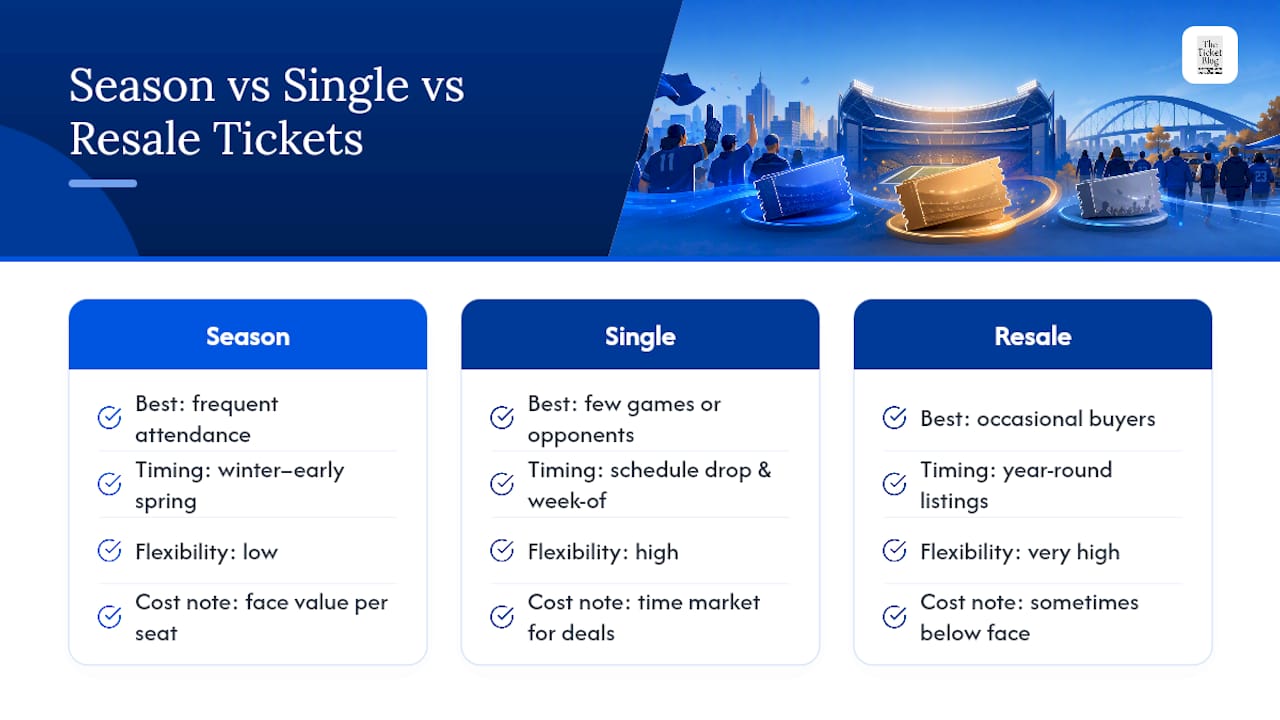
Season tickets make sense when you know you’ll attend, or resell, most home games and you value guaranteed seat location over price flexibility. Teams typically release season ticket renewal windows and new packages in the winter and early spring, well before the single-game schedule even drops. If you’re on a season ticket waitlist for a popular team, that’s often your only realistic path to season seats at face value.
Single-game tickets are the better call for fans who only want to attend a handful of games, want to pick specific opponents, or aren’t ready to commit to a full season’s price tag upfront. The flexibility cuts both ways, though: you get to time the market using the windows described above, but you also compete against everyone else doing the same thing for high-demand games.
A middle path worth considering: some teams and season ticket holders resell partial plans or individual games from their packages, sometimes below face value if they can’t attend. Watching secondary listings tied to season ticket holders can occasionally beat both the schedule-release window and the week-of discount, especially for teams with softer season-long demand. If you’re deciding between locking in a season plan or staying flexible game by game, the honest answer depends on how many games you actually plan to attend each year. Below four or five games, single-game buying with disciplined timing usually wins on cost.
Buying For The Playoffs, Super Bowl, And International Games
Playoff tickets follow almost none of the rules that apply to the regular season. Prices climb as a team’s playoff position solidifies, and by the time a home playoff game is confirmed, you’re often buying in a compressed window of days rather than weeks. If your team is in playoff contention in December, start watching listings before the bracket is finalized. Waiting for certainty usually means waiting for the highest price.
The Super Bowl operates on its own timeline entirely, with prices typically climbing steadily from the moment the two teams are confirmed through kickoff. There’s rarely a meaningful week-of discount the way there is for regular-season games, since total demand vastly outstrips supply. If attending is a priority over price, earlier is almost always better once your team clinches its spot.
International games, including London and international showcase matchups, come with their own quirks. Travel costs often dwarf ticket costs, and because these datasets are frequently excluded from standard resale analyses, the domestic week-of discount pattern doesn’t reliably apply. Book travel and tickets together, and expect less price movement close to the date than you’d see for a typical U.S. regular-season game.
For any high-stakes purchase, whether it’s a playoff game or a rivalry showdown, having a backup plan matters. If your target game sells out before you commit, sold-out game alternatives can help you find a realistic path in instead of overpaying at the last minute.
One Fan’s Take: Buy Early For Rivalries, Wait For Everything Else
An editorial stance is simple: match your buying window to the game, not to a single rule you apply universally. Waiting always feels smarter until the one time it isn’t.
Consider two scenarios that play out every season. A fan waits on a midseason game between two mediocre teams, and by the Friday before kickoff, prices have dropped noticeably as sellers unload tickets they no longer want. A different fan takes the same approach with a division rivalry game and watches seat options disappear entirely by the time the “smart” week-of window arrives, leaving nothing but overpriced upper-deck seats.
Both outcomes are predictable once you separate games by demand level instead of treating every purchase the same way. Pick one consistent strategy based on the matchup type, not on last season’s outcome for a completely different game.
— The Ticket Blog
Knowing the right window is only half the battle. Acting on it before prices move requires alerts, curated deal roundups, and a checklist you can actually follow under time pressure, and some guides build around these needs. These guides pull together marketplace comparisons, fee breakdowns, and timing frameworks so you’re not starting from scratch every time a new matchup catches your eye.

A few quick next steps if you want to put this guide into practice:
Bookmark this timing checklist and revisit it before every schedule release.
Compare current listings across platforms using The Ticket Blog’s 2026 NFL deal roundup.
Check fee structures before you buy with help from winVIPtix’s guide to avoiding resale fees, especially if you’re comparing totals across marketplaces.
Ready to see what’s available for your target matchup right now? Visit The Ticket Blog to browse current guides and start applying these timing rules to your next game.
Sources
FAQ
How Far In Advance Should I Buy NFL Tickets?
For premium rivalries and prime-time games, buy as soon as the schedule releases in May. For lower-demand matchups, you can often wait until 3 to 7 days before kickoff and still find good availability.
When Can I Start Buying 2026 NFL Tickets?
The NFL typically releases its full season schedule in mid-May, which opens the earliest and often cheapest buying window for most 2026 games.
Do NFL Ticket Prices Go Down Closer To The Game?
Yes, for many non-premium matchups.
What Is The Cheapest Time To Buy NFL Tickets?
Gameday and the week leading up to kickoff tend to produce the lowest prices for lower-demand games, saving buyers roughly $20 per ticket on average. Rivalry and prime-time games rarely follow this pattern, since demand stays high right through kickoff.
Recommended



Comments