How to Find Hidden Ticketing Promo Codes in 2026

Updated: Sep 27

Hidden ticketing promo codes are discount strings tied to specific events, platforms, or cardholder programs that never appear on a public coupon page. They unlock lower prices, early access, or reserved inventory that general buyers never see. Knowing how to find hidden ticketing promo codes puts you ahead of the crowd on Ticketmaster, Live Nation, and theater box offices before seats sell out. This guide covers every reliable channel, the tools you need, and the mistakes that cost fans money every season.
What do you need before searching for hidden promo codes?
The right setup makes the difference between finding a code in minutes and spending hours empty-handed. Three accounts form the foundation: a Ticketmaster account, a Live Nation account, and an ID.me profile for verified discounts. Live Nation’s All Access membership is free and automatically unlocks presale access for select events upon login, removing the need to hunt for a code at all.
Credit card programs are the second pillar. Amex, Citi, and Chase distribute unique presale codes through cardholder portals and marketing emails. These codes are event-specific and available only to eligible cardholders. If you carry one of these cards, check your account portal before any major on-sale date.

The table below summarizes the core tools and what each one delivers.
Tool or Program | What it provides |
Ticketmaster account | Access to fan presales and credit card partner offers |
Live Nation All Access | Automatic presale unlock for qualifying events |
Amex, Citi, or Chase portal | Cardholder-exclusive presale codes |
ID.me verification | Up to 10% off for military, students, and teachers |
Artist or venue newsletter | First-look codes before public on-sale |
Pro Tip: Set up a dedicated email address for ticketing newsletters. It keeps promo codes organized and prevents them from getting buried in your main inbox.
Beyond accounts, browser extensions like Honey or Capital One Shopping scan for active codes at checkout. They will not find every hidden event promo code, but they catch automatic discounts that apply without any code entry.
Where to find secret ticket discounts and hidden event promo codes
The most reliable sources for exclusive ticket promo offers are official channels, not third-party coupon aggregators. Here is where to look, ranked by consistency.
Artist and fan club newsletters. Fan clubs and artist newsletters are among the most dependable sources for limited-use presale codes. Sign up directly on the artist’s official website. Codes from these lists often go live 48–72 hours before the general public on-sale.
Venue and promoter mailing lists. Venues like Madison Square Garden, the Hollywood Bowl, and local amphitheaters maintain their own subscriber lists. Promoters such as Live Nation and AEG Presents send targeted offers to subscribers for shows at their owned venues.
Credit card cardholder portals. Log into your Amex, Citi, or Chase account and look for the entertainment or events section. Codes here are tied to your card number and cannot be shared or resold.
Social media channels. Artists, radio stations, and venue accounts on Instagram, X (formerly Twitter), and Facebook post time-sensitive codes, often with a 24-hour window. Follow official accounts and turn on post notifications for artists you follow closely.
Verified deal sites and coupon platforms. Sites like RetailMeNot and Honey aggregate codes that users have confirmed as working. These are more useful for secondary market platforms than for primary sellers like Ticketmaster.
In-cart automatic discounts. Many discounts apply automatically after you add tickets to your cart, with no code entry required. Always add tickets to the cart and review the price before assuming the face value is the final price.
Media partner and promoter holds. After an initial sellout, media partners and promoters sometimes release reserved seats through marketing holds with a promo code or special link. These batches are small and time-limited, so monitoring artist social channels after a sellout is worth the effort.
Pro Tip: Check the TKTS Discount Booths in New York City for same-day Broadway tickets at up to 50% off for productions like & Juliet, Chicago, and The Outsiders. No promo code is needed. You purchase on-site the day of the show.
For a deeper look at how presale access works across platforms, The Ticket Blog’s guide on presale ticket access explains the full timeline from fan club windows to general on-sale.
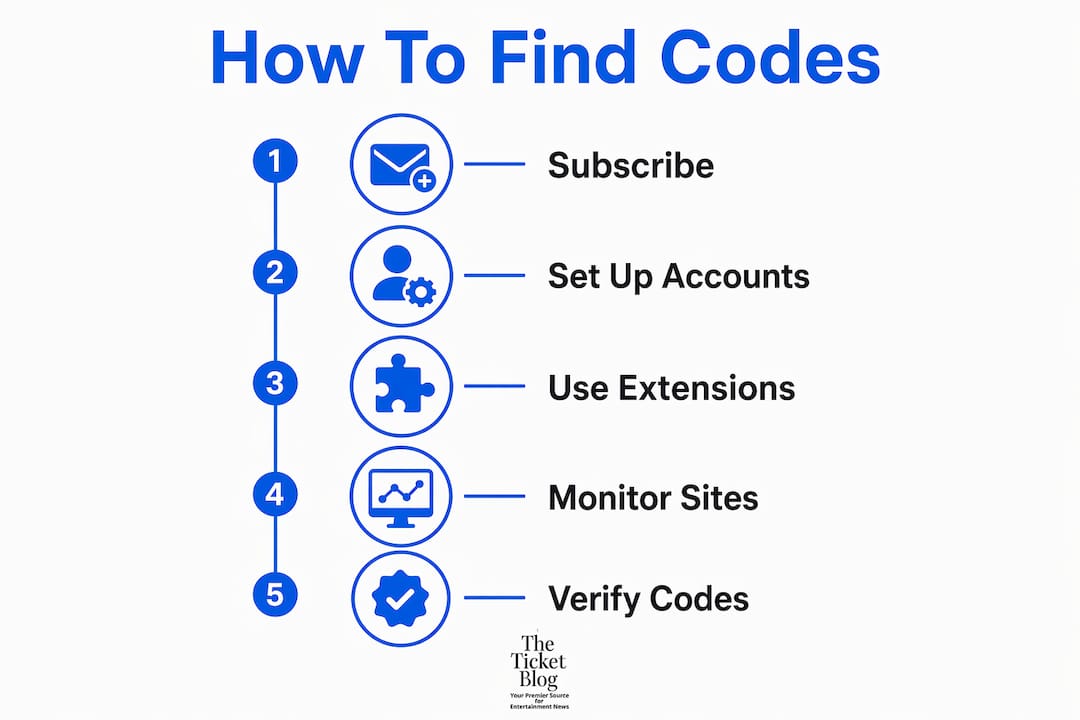
How do you apply and verify a promo code when buying tickets?
Applying a code correctly is as important as finding one. Follow these steps to avoid errors and confirm your discount before completing payment.
Select your tickets and proceed to checkout. Do not enter a code on the search page. Most platforms, including Ticketmaster and Live Nation, display the promo code field only after you select seats and begin the checkout process.
Locate the promo code field. On Ticketmaster, the field appears on the order review page. On Live Nation, it shows up in the payment section. Look for labels like “Promo Code,” “Offer Code,” or “Discount Code.”
Enter the code exactly as provided. Codes are case-sensitive on most platforms. Copy and paste directly from the source email or portal to avoid typos.
Verify the discount before paying. The order total should update immediately. If it does not change, the code may be expired, region-restricted, or tied to a different event.
Check eligibility requirements. Some codes require you to be logged into a specific account. Vivid Seats offers a 10% discount capped at $30 for verified military members, students, teachers, and first responders through ID.me. That discount only applies after you complete ID.me verification and log in.
Common error: If a code returns a “not valid” message, confirm the event date, your account login status, and whether the code is tied to a specific credit card. Ticketmaster’s presale codes are event-specific and unique to credit card holders or fan club members. There is no universal code that works across all events.
Automatic vs. code-based discounts work differently. Automatic discounts apply at checkout without any entry. Code-based discounts require the field to be filled in before the price updates. Knowing which type applies to your purchase saves time and prevents you from leaving money on the table.
Common mistakes that kill your chances of finding ticket code deals
Most buyers make the same errors. Avoiding them puts more savings in your pocket.
Searching for a universal Ticketmaster promo code. Ticketmaster rarely offers sitewide promo codes due to dynamic pricing. Savings come from targeted presales and credit card partnerships, not broad discount codes.
Buying codes from third-party sellers. Third-party presale code sellers frequently provide expired or invalid codes. You pay for a code that does not work and have no recourse for a refund.
Skipping automatic discounts. Many buyers go straight to the promo code box and miss discounts that apply without any code. Always review your cart total before entering anything.
Missing the presale window. Presale codes have strict time windows, often 48–72 hours before general on-sale. A code that worked on Tuesday may be invalid by Thursday morning.
Ignoring region and eligibility restrictions. Some codes are valid only for buyers in specific states or for cardholders of a particular bank. Read the terms attached to every code before attempting to apply it.
Not checking after a sellout. Production holds and marketing holds mean reserved seats can reappear after an event shows as sold out. Checking artist and venue channels 24–48 hours after a sellout has uncovered real inventory for many fans.
Pro Tip: Always verify a promo code source before using it. Codes from official artist websites, credit card portals, and venue newsletters are legitimate. Codes posted on random forums or sold through social media DMs are almost always scams.
Key Takeaways
The most reliable way to find hidden ticketing promo codes is to combine official newsletter subscriptions, credit card cardholder portals, and in-cart discount checks before every purchase.
Point | Details |
Official sources are most reliable | Artist newsletters, venue lists, and credit card portals provide legitimate, working codes. |
Automatic discounts require no code | Always check your cart total before entering a promo code. |
Presale windows are time-sensitive | Fan club and credit card codes typically expire 48–72 hours after release. |
Universal codes rarely exist | Ticketmaster and Live Nation use event-specific codes, not sitewide discounts. |
Verify before you buy | Confirm code eligibility, region, and account login before completing checkout. |
The Ticket Blog’s take on finding promo codes in 2026
The single biggest shift I have seen in ticket discounts over the past few years is the move away from public coupon codes toward access-based discounts. Platforms are not hiding codes on coupon pages anymore. They are distributing them through credit card partnerships, fan club memberships, and cardholder portals. If you are not plugged into those channels, you are not seeing the real price.
The fans who consistently pay less are not lucky. They have a system. They sign up for newsletters the day an artist announces a tour. They log into their Amex or Citi portal before the on-sale date. They add tickets to the cart and check the price before assuming face value is the floor.
One thing that surprises most people is how often production holds and marketing holds release real inventory after a show appears sold out. I have seen this happen with major arena tours and Broadway productions alike. The seats exist. They just need a specific link or code to unlock. Monitoring official channels after a sellout is one of the most underused strategies in the budget buyer’s toolkit.
The challenge in 2026 is that dynamic pricing has made face value a moving target. A code that saves you 10% on a $60 ticket matters a lot less when the base price has already doubled due to demand. The best defense is acting early, using presale access, and treating automatic cart discounts as your first line of savings before any code search begins.
— The Ticket Blog
Stay ahead with The Ticket Blog’s latest promo code updates
The Ticket Blog tracks hidden event promo codes, presale windows, and exclusive ticket deals across concerts, sports, and theater events year-round. Whether you are looking for summer concert discounts or trying to score last-minute Broadway seats, the site posts verified codes and savings guides updated for 2026. You can also explore The Ticket Blog’s full breakdown of hidden ticket fee discounts to cut costs beyond the base ticket price. Bookmark The Ticket Blog and subscribe to the newsletter to get promo codes and deal alerts delivered directly to your inbox before they expire.
FAQ
What are hidden ticketing promo codes?
Hidden ticketing promo codes are discount strings distributed through restricted channels such as artist newsletters, credit card portals, and fan clubs rather than public coupon pages. They unlock lower prices or early access to tickets that general buyers cannot see.
Do universal promo codes exist for Ticketmaster?
No. Ticketmaster does not offer sitewide promo codes due to dynamic pricing. Discounts come from event-specific presale codes tied to credit card programs or fan club memberships.
How do I get Broadway rush tickets at a discount?
The TKTS Discount Booths in New York City sell same-day and next-day Broadway tickets at up to 50% off for select productions. No promo code is required. The Ticket Blog’s guide on Broadway rush tickets covers additional methods for last-minute theater savings.
Are promo codes from third-party sellers safe to use?
No. Third-party sellers frequently provide expired or invalid codes. Always source codes from official artist websites, venue newsletters, or verified credit card cardholder portals to avoid losing money on a code that does not work.
What is the difference between a promo code and an automatic discount?
A promo code requires manual entry in a checkout field to apply a discount. An automatic discount applies to your cart total without any code entry. Checking your cart price before entering any code reveals whether an automatic discount is already active.
Recommended


Comments